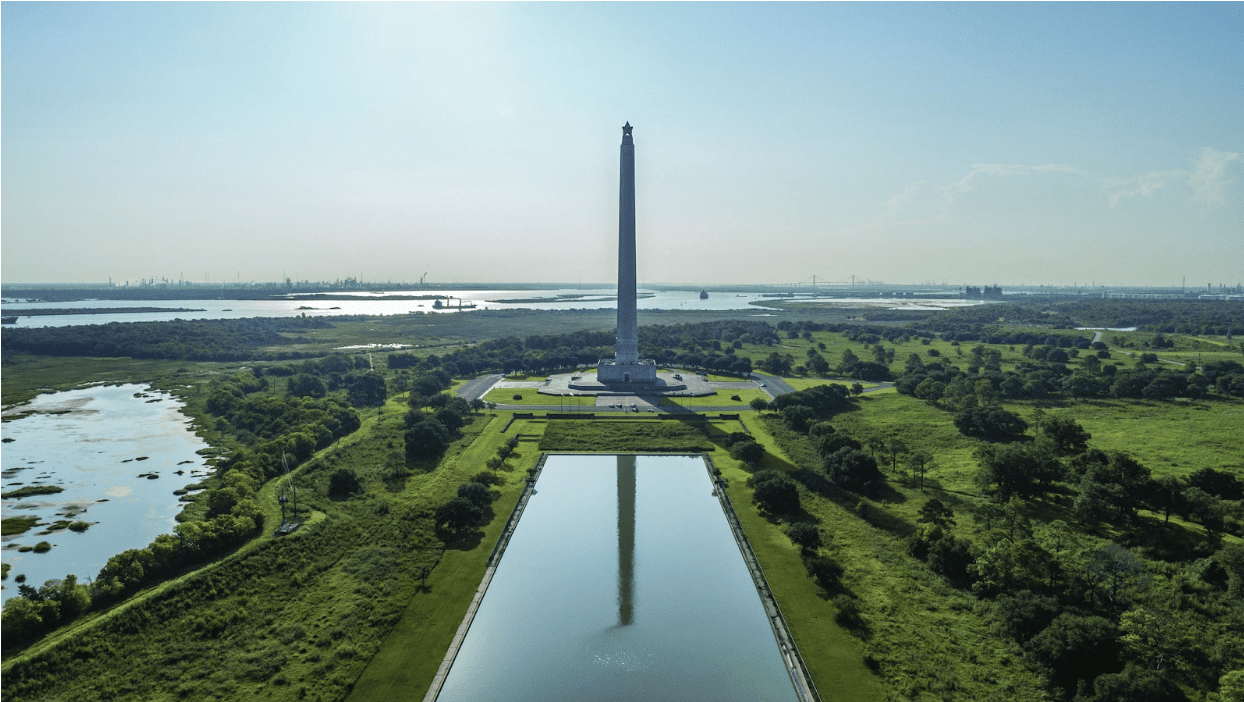

People often retain memories of important events for a very long time. Symbolic monuments are built to commemorate the most significant events so that future generations can be aware of them as well. Without a doubt, the victory in the Battle of San Jacinto was a watershed moment for Houston, and perhaps all of Texas. A stele known as the San Jacinto Monument was built at the site of the battle for future generations to remember and perpetuate the feat of the fight for independence. Learn more at i-houston.
The fight for Texas independence
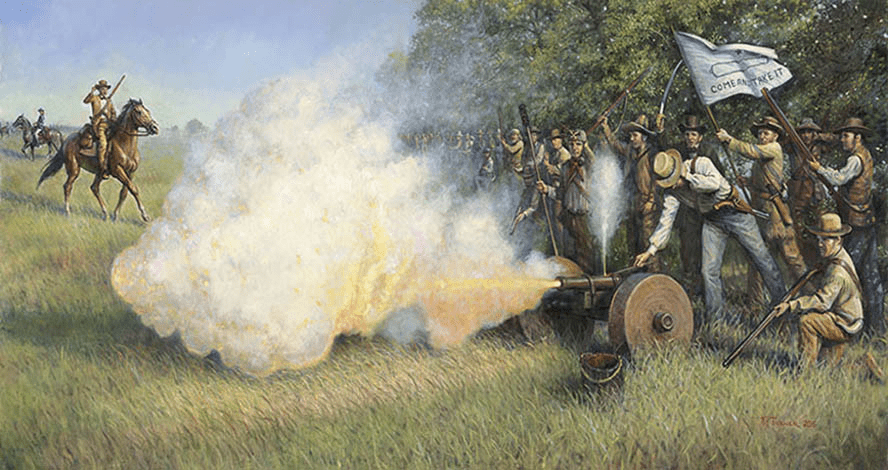
Texas’ war for independence was brief, but it had the potential to cause catastrophic effects for its statehood. The period between October 1835 and March 1836 was challenging and desperate. The protesters, who sought independence from Mexico, had nothing except enthusiasm and a meager arsenal of weapons. As a result, the Mexican authorities did not consider them a significant threat, so they dispatched an army led by Antonio López de Santa Anna to suppress them. For a seasoned general, the effort seemed to be simple to handle. That was the case at first. The advantage in human resources allowed for a quick drive back against the rebels. The greatest issue for the Anglo-Americans was a lack of professional command. It was led by lawyer Sam Houston, who was among the few who had military experience. The newly appointed general acted wisely. Seeing the enemy’s superiority, he did not lead people into a reckless battle. They retreated for six weeks, taking advantage of every chance to train their troops. Then, Santa Anna, who often called himself the Napoleon of the West, took control of the Alamo, Texas’ largest settlement at the time. It was a catastrophe. The rebels got disillusioned and began to flee, particularly after learning that the Mexicans had executed all of their prisoners. Houston managed to maintain control over them only by promising free land in the liberated territories. The Mexicans became enthralled by the quick progress of their advance, losing their alertness and common sense of battle, which General Sam took advantage of. Antonio López arranged his army of thousands into several divisions and spread them across vast territory. Texian scouts reported this to the rebels. Samuel Houston learned of the location of the Mexican commander-in-chief and hurried with his forces there. Choosing an opportune moment, he launched an unexpected offensive and completely defeated the enemy camp, destroying an entire commander tier. Although Santa Anna escaped, he was apprehended and brought to Houston, who was shot in the ankle. So infamously, the Napoleon of the West was forced to capitulate and sign a treaty recognizing Texas’ independence. Thus, a troop of Texans, which was several times smaller than the regular Mexican army, was able to defeat the enemy with few casualties and achieve the desired independence.
Symbol of Texas independence
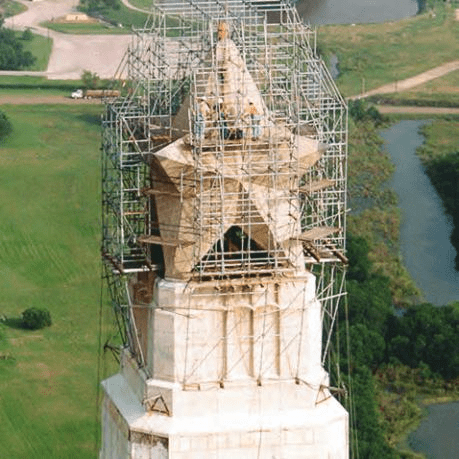
Such a triumphant victory deserved to be memorialized. The newly founded Texas Veterans Association planned to erect a monument on the site of the battle. However, it wasn’t until 1897 that the site of the decisive fight was examined, cleared and designated as a state park. Despite the significant efforts of eyewitnesses and participants in the war of independence, the matter did not advance, and discussions about it eventually ceased. They returned to the idea of building a monument on the eve of the battle’s 100th anniversary. Public figures in Houston and throughout Texas recognized the need to preserve the historic site and the memory of the Texas Revolution. Then, a competition for the best monument project was announced. Among all the works, Robert J. Cummins, an architect who studied at the University of Houston, was named the best. The monument’s construction began the same year the project was approved. According to the plan, it was intended to be a tall stele with a star on top, representing free Texas.
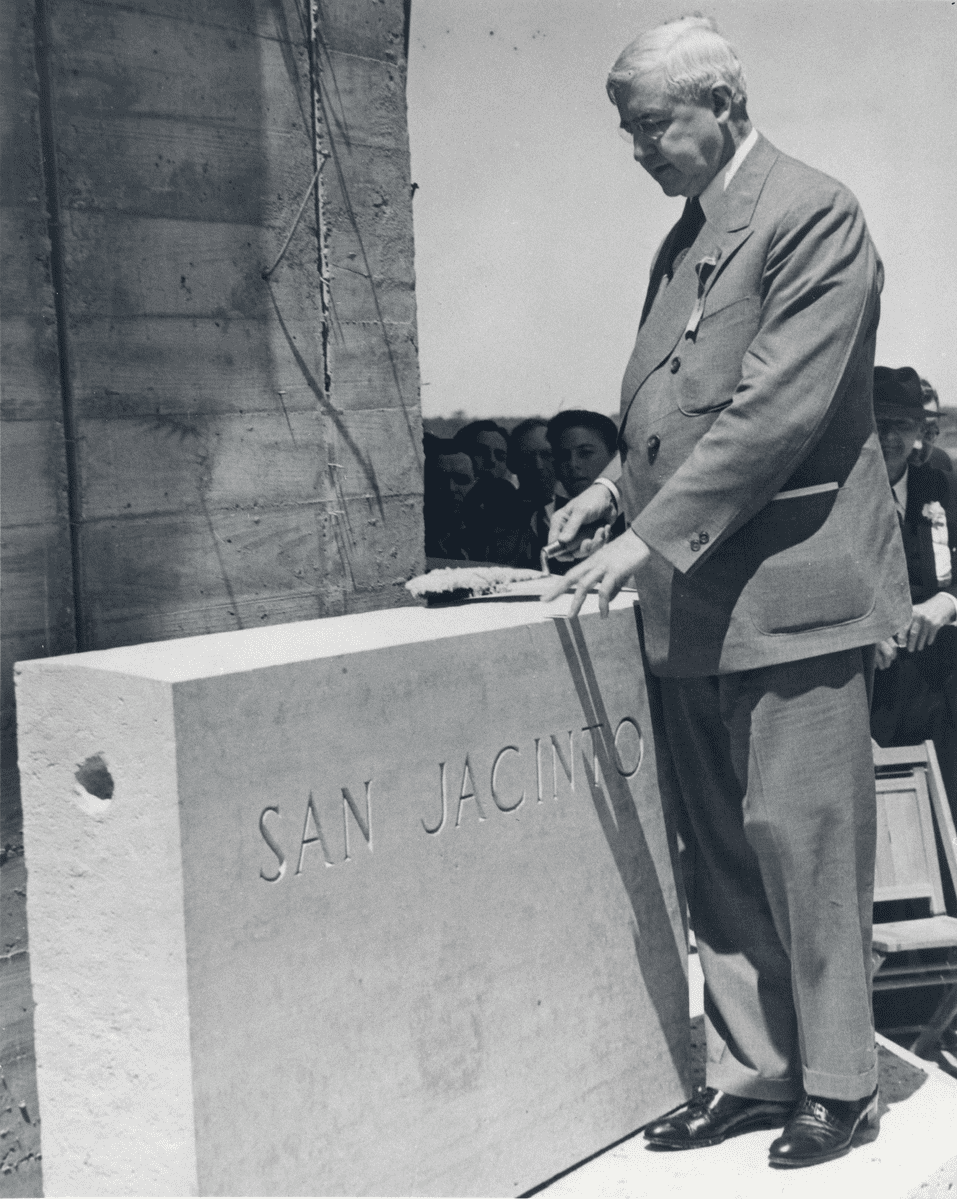
The tender was won by a Dallas-based company. It offered to build the monument for $888,300. Converting to the beginning of the twenty-first century, the sum would be 22 million dollars. Work began symbolically on April 21, 1936, the centenary of the battle. Following the official laying of the cornerstone, they began filling in the monument’s base. At this point, we should pay respect to the engineers who carried out the calculations. The territory of San Jacinto is very swampy and uneven. Therefore, creating a structure of this size and weight was a real challenge. Nevertheless, they accomplished it. The monument’s base alone was filled with 5,700 cubic meters of concrete. The work was carried out nonstop for 57 hours by 150 workers. The walls of the monument were built of Texas limestone. They are attached to eight carved panels depicting key stages in Texas’ formation. The history of the fight for independence is inscribed on the very foundation. The memorial is completed by a tall monument, the world’s tallest concrete structure and the tallest military monument. It stands more than 170 meters tall. The stele is completed with a large star, which is a symbol of the state. At the top of the monument, there is an observation platform where visitors can observe the historic battlefield as well as the vistas and panoramas of the Houston Ship Channel. A powerful elevator is used for lifting, traveling at 3.5 meters per second.
Opening of the memorial
With great respect, the people who lived in the nearby towns and villages were eagerly awaiting the monument’s opening. It was scheduled for April 21, 1939, the day Mexico signed its surrender. The event received considerable international attention. Many representatives from the United Kingdom, France, Italy, China, the Dominican Republic and even the Vatican attended the opening ceremony. Texas Governor W. Lee O’Daniel’s speech was broadcast over the radio to reach as many people as possible. All of the two-day opening festivities featured performances by composite orchestras from the local schools. Houston firefighters provided free security and law enforcement services.
Over 175 thousand individuals visited the monument during its first six months of existence. The millionth visitor was registered in 1941. The monument is currently an interesting destination for tourists and residents of the United States.
Museum, wedding venue and annual festival
It would be natural to locate a museum adjacent to such a monument that would commemorate this historical event. Thus, one man spent the majority of his life gathering knowledge and artifacts related to the battle. He was revealed to be a descendant of the combatant George Alfred Hill. His grandfather served in the war, and his father was an advocate for the purchase of land for the memorial. George collected documents for over 25 years, which included traveling to Mexico particularly to locate and purchase materials related to those events. He eagerly agreed to donate his exhibits to the museum. In exchange, grateful citizens offered him the position of head of the institution. Subsequently, the commission decided to expand the museum’s collection to encompass all of Texas’ history. Today, the institution houses exhibits chronicling the region’s 500-year history of development.
The entire area surrounding the monument is part of a national historical park protected by the state. It is available to the public and serves as a popular venue for wedding ceremonies. Beautiful vistas, the ability to climb to the observation deck and a somewhat busy area all entice newlyweds looking to legitimize their feelings for one another.
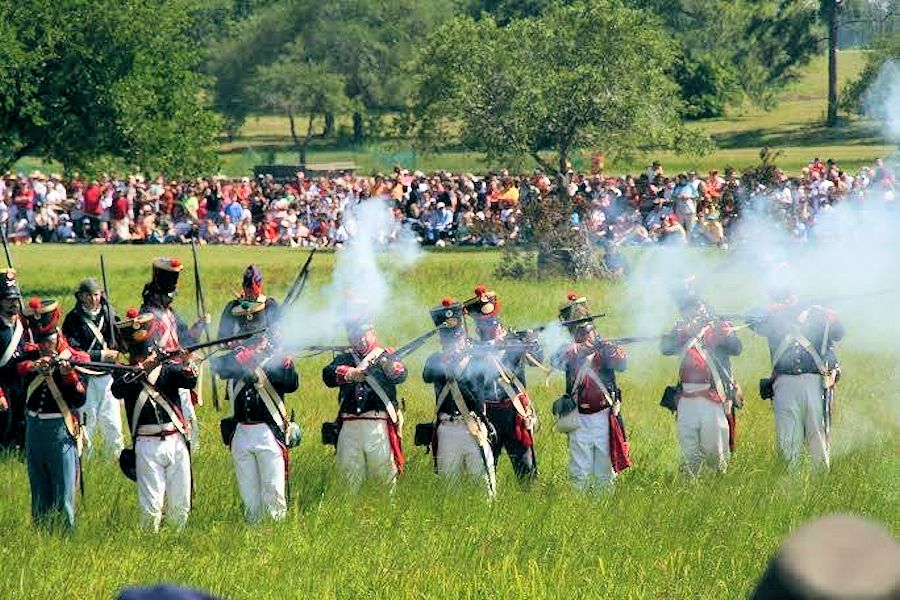
Every year on April 21, the anniversary of the battle, a grandiose historical festival takes place around the monument. Its visitors recreate the battle as part of the celebrations. A huge number of artists and fans of similar events are drawn to the event. They dress up in military uniforms of the time and act out a battle scene. All of the action is accompanied by music, entertainment and the consumption of various treats.
The San Jacinto Monument is more than just a structure to commemorate the battle. It is also a symbol of the fight for freedom and the hope for a brighter future, as well as a symbol of sacrifice and invincibility. It is a symbol of Texas’ heroic past and a source of national pride.